... or: The total chaos of politics, man!
I'm sorry for going "off-topic" today, but the things that have been going on in Austrian law just make me so, so angry! Please forgive me, but I have to share this.
Posts mit dem Label europe werden angezeigt. Alle Posts anzeigen
Posts mit dem Label europe werden angezeigt. Alle Posts anzeigen
Donnerstag, 6. Juli 2017

Donnerstag, 13. Oktober 2016
European Bachelor Kitchen - It's Schnitzel time!
The famous Schnitzel
Yes. Schnitzel is a staple of Austrian cuisine. Yes, we actually eat it quite a lot. And yes, it's fatty and protein-rich and probably not very good for your cholesterol, but we also walk a lot. I mean, a LOT. So there's that, I guess.
 |
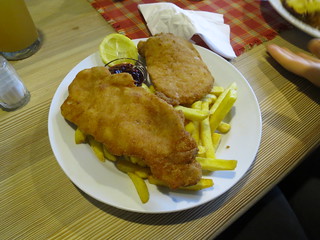
| This is not a Schnitzel. This is an abomination. |
There's not much to say about a real Schnitzel, honestly. Austrians are puritans when it comes to their traditional cuisine, which means: No fancy stuff. The less ingredients, the better, and nothing to scare your pretty little eye away from that awesome, battered piece of bread-crumbed goodness. Which is why I added that foto up there. That's some sadistic stuff going on there, with all that sauce and salad, not cool!
A true Schnitzel is able to hold its own, all by its little lonesome. There are some high-end restaurants who actually try to make Schnitzel some kind of fancy dish, but neither does it stick, nor do most people like it. If you can't make your flat piece of meat set hearts on fire by itself, please don't try to hide that sad fact behind lettuce.
 |
| .. or potatoes. |
Also, Schnitzel has its own fast-food-chain in Austria, called "Schnitzelhaus". It's so popular, it already has loads of competition, the "Schnitzlplatzl" for example. They do try to fancy up the Schnitzel with a few varieties, such as the Hawaiian Schnitzel or the turkey or pork variety, but for most of the time, the Austrians stick to their classic veal.
It's important to know how something is supposed to taste before you go off the rails and dip it in gravy or sauce hollandaise, or some other horror, so here you go: I give you the generic, Austrian Schnitzel recipe!
 |
| Come here, my pretty little angel! |
What you need
- Slabs of veal, cut half as thick as a finger (about)
- All-purpose flour
- Milk
- Eggs
- Breadcrumbs (fine ones are better)
- Salt
- A fryer (ideal) or a deep pan and lots of lard/frying oil
- A meat mallet!
And here's how it's done!
It's rather easy, honestly. As you noticed, I didn't add any quantities to the ingredients, because for the life of me, I couldn't tell you how much I actually need. I simply take three soup plates and work my way through, adding stuff whenever I run low. But let's start from the beginning!It all starts with the slabs of veal and the meat mallet. Combine the two in a pounding manner until the veal is flattened like an opossum on the highway, on both sides. I usually work my way through all of the meat, stack the pieces I pounded, and then go on to the crumbing part. I honestly don't know how to use a fryer, so if you've got one of those, make sure it's warming up at this point, because as soon as those babies have met the bread crumbs, they should meet their heated maker.
But! Back to the crust. As I said, you need three soup plates or some other containers big enough to drag your pounded pieces of veal through.
The flour goes into the first plate, just enough to fill it to half.
A good swig of milk and two eggs go into the second platter and get scrambled to a thick goo. As long as it's good and yellow/orange, don't worry too much, just mix it well.
The breadcrumbs go into the third plate, a little more than the flour but not too much, or you'll dirty your kitchen.
With this done, your frying station should be up and running on two thirds of heat - not too hot, not too cold.
Each pounded slab of veal needs a sprinkle of salt and pepper on each side. Rub it in and then proceed to move the veal through the three plates, covering them each first in flour, then in egg/milk, then in breadcrumbs. Make sure to be diligent here, no empty spots, no sticky edges!
Into the fryer for about five to seven minutes, with the frying pan version you'll need to carefully shake it here and there, so the fat can slosh over the edges and fluff up the crust. Also: Using a pan means you'll have to do both sides for about five minutes!
Aaand that's it. Out of the fryer, maybe dab it a little with kitchen paper to get off the excess of fat, and onto the plate. We usually eat it with a pinch of lime drizzled over the crust, fries on the side and maybe a potato salad, but it tastes rather good with ketchup or mayonnaise too.
Why this is a bachelor dish
Well, to be honest, it isn't. And it is, because look at the ingredients! I usually have all of those at home, because they are staples in many, many Austrian dishes, which means: If I want to treat myself to a Schnitzel, I just have to buy the veal, and off I go. As a bonus, cooking Schnitzel will always, ALWAYS put you in the good graces of your guests! If they're not vegetarian, I guess, hm.Anyhow! That's it for the Schnitzel!
Love,
Hannah
Dienstag, 6. September 2016
European Bachelor Kitchen
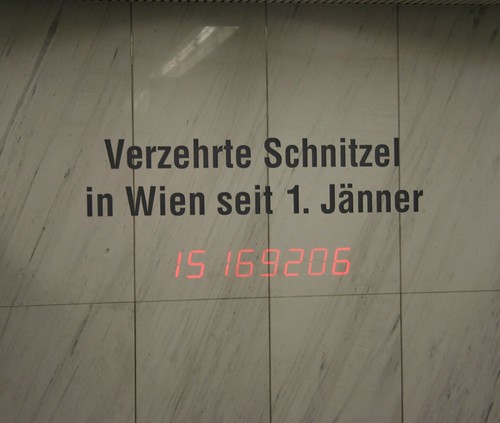 |
| "Consumed Schnitzels in Vienna since January 1st:" |
I'm a foodie. I love food, eating out, cooking, trying new things, doing the whole nutrition thing guerilla-style. This may be one reason why I'm always wondering what other people have in their fridges, especially in other countries. I mean, I know what Germans do, because their cuisine is very similar to traditional Austrian cuisine, except for the thing where we cook totally different meals out of the same ingredients and name them after each other's cities and all that.
I try to replicate dishes from other countries, but there is no way for me to know which of those are recipes a single household would cook regularly, or what the "great 10" are; I mean the ten most wide-spread dishes of a country (or county), because those are the dishes that actually give a feel for the "taste" of a people.
I tend to not believe master chefs, TV shows or online advisors, though. Have you ever watched those? The amount of fresh ingredients is staggering, and who the hell has Mascarpone just standing around to whip up with five different freshly chopped herbs after a nine-hour-day?
No. People don't eat like that as long as there are no children to feed or guests to impress. But what do you eat, then?
There must be other people out there, wondering too. I'll go first and try my best to describe Austrian singles cuisine, but not today, because this will take time. In the next few weeks, I will post my most common food items, the stuff I always keep in stock, and the ten dishes I cook most often and also like best.
I'll even add the recipes, for those of you brave enough to try post-war cuisine!
And here's the runner-up for next week, place 10 on my food scale...
... you guessed it. Schnitzel!
Donnerstag, 18. August 2016
Meanwhile, at the zoo...
Fun fact: Austria has the world's oldest zoo. Schönbrunn has been around about as long as people realized that nature isn't all about "wow, that thing is just there", and whereas other old zoos stuck to their traditional, antiquated ways, Schönbrunn modernized and did everything it could to secure its place as a top institution for species preservation.
Our pandas are world famous! Schönbrunn is one of the few zoos not only equipped but more than able to help those rare bears procreate on such a regular basis, we actually ship most of the offspring back to China to restock their population and genepool with healthy new bears.
And right now, cuteness ensues at the Panda enclosure, because TWINS, people!
Here's a close-up of the surprise double-whammy:
D'aaaaw!
Our pandas are world famous! Schönbrunn is one of the few zoos not only equipped but more than able to help those rare bears procreate on such a regular basis, we actually ship most of the offspring back to China to restock their population and genepool with healthy new bears.
And right now, cuteness ensues at the Panda enclosure, because TWINS, people!
Here's a close-up of the surprise double-whammy:
D'aaaaw!
Dienstag, 16. August 2016
Hannah's Real-Life: Studying
Although most of my stories play in either fictional universes or the U.S. of A., I'm from Europe and have never been to the Americas (except for Costa Rica, but never mind that). In these days, it almost doesn't matter where a person is from, we are all interconnected and global and able to exchange information in a matter of glimpses from one end of the world to the other; I sometimes catch myself suppressing this fact and then being surprised that people don't know how things work in my part of the world.
To remedy this, here's a small piece about studying in Austria (and Germany for that matter, it's rather similar).
There are three types of institutions a person can go to after highschool, which is called either "Oberstufe des Gymnasiums", meaning something like senior classes of secondary school, or senior classes in HAK, HTL, and other abbreviations that ultimately stand for specialized secondary schools (HAK is business/economy oriented, HTL is technology oriented):
A university is a publicly funded institution with EU-wide recognized degrees and certificates, whereas a college is a privately funded institution with sometimes rather dubious degrees and certificates, that sometimes are recognized in the U.S., but nowhere else.
Hence, most people go to university or an FH, because honestly, certificate! Also, both of those types of institution are more or less for free. It's true that there are costs at some point, but those are aimed at what we lovingly call "bemoostes Haupt", or "mossy heads", people who spend their whole life doing nothing but being a student.
But back to universities!
The most poignant difference to the U.S. is its structure in general. Universities consist of a multitude of buildings and branches that are scattered all over a city, a little like this:

Each of those buildings represents a main branch of studies and unifies another dozen or so of institutes that are - again - scattered over the city like confetti on your birthday party. When I studied biology, I sometimes had to take the cable cars and subway trains two or three times a day to get from one lecture to the next and spent most of my time in public transport, reading and working through my notes.
There's also no boarding for students. Hah, well, there is, actually, but it looks a little like this:

Nope, no walking out of your room and into the lecture hall for us! Everyone has to organize their own living situations, which often means renting an apartment and sharing it with someone, buying your own tickets for the subway and cable car and cooking your own meals. That whole "free education" stint actually costs a ton of money, because you still have to pay rent, buy food, pay taxes and get your own books and hardware, and although there are special concessions for students, studying still adds up to a hefty monthly sum. Students here are required to act like adults, at least in some aspects.
Which brings me to lecture plans, because holy hell, that's some crazy stuff.
Nobody. Tells. You. What. You. Need.
I am not kidding. You register for your major and get some kind of table with modules on it, very basic stuff. So-and-so-many ECTS (study points) to finish module this-and-that, that's all. Or not, because now you have to work through a database of each and every lecture, seminar, field trip, tutorial, laboratory course and whatever else might be needed for any and every field of study offered at one city, all of them sorted by index numbers and rather nebulous specifications as to what module might be influenced by taking it.
An example:
Those letters and numbers down there are Modules from eight different specializations a biology bachelor student can choose. This lecture is one of up to thirteen different lectures per each and every specialization, and most of them aren't recurring, so even older students aren't always able to help. In some semesters, there aren't enough lectures or courses to fill the required ECTS amount a student needs to keep his education free of charge, so planning my lectures and courses sometimes felt like choosing battle tactics to me.
Nobody monitors your success or how much you study but yourself and your parents. There are no notices and no report cards if you don't actively pursue getting one (for special concessions, for example), and nobody nags you to take exams or work harder. All of it rests on a student's shoulders and if he doesn't apply himself, well. At some point he'll have to pay a semester entrance fee, and at some later point - especially if a student repeatedly fails an exam - he'll be expelled, but that's it.
I failed at biology, partly because I underestimated the amount of work I'd have to put in just maintaining my education, but partly because I'm just not that into science. I found this out in my third year, failed an exam three times and decided to let it be.
Not studying, though. I'll be taking my entrance exam for a lectureship major at the end of August and start this madness over!
This time, I'll keep you up to date and entertain you with tales of European education, because why not? You already know how America works. Time for new insights!
Love,
Hannah
To remedy this, here's a small piece about studying in Austria (and Germany for that matter, it's rather similar).
There are three types of institutions a person can go to after highschool, which is called either "Oberstufe des Gymnasiums", meaning something like senior classes of secondary school, or senior classes in HAK, HTL, and other abbreviations that ultimately stand for specialized secondary schools (HAK is business/economy oriented, HTL is technology oriented):
- University,
- College,
- Fachhochschule (FH) - something like technical college or polytechnic
A university is a publicly funded institution with EU-wide recognized degrees and certificates, whereas a college is a privately funded institution with sometimes rather dubious degrees and certificates, that sometimes are recognized in the U.S., but nowhere else.
Hence, most people go to university or an FH, because honestly, certificate! Also, both of those types of institution are more or less for free. It's true that there are costs at some point, but those are aimed at what we lovingly call "bemoostes Haupt", or "mossy heads", people who spend their whole life doing nothing but being a student.
But back to universities!
The most poignant difference to the U.S. is its structure in general. Universities consist of a multitude of buildings and branches that are scattered all over a city, a little like this:

Each of those buildings represents a main branch of studies and unifies another dozen or so of institutes that are - again - scattered over the city like confetti on your birthday party. When I studied biology, I sometimes had to take the cable cars and subway trains two or three times a day to get from one lecture to the next and spent most of my time in public transport, reading and working through my notes.
There's also no boarding for students. Hah, well, there is, actually, but it looks a little like this:

Nope, no walking out of your room and into the lecture hall for us! Everyone has to organize their own living situations, which often means renting an apartment and sharing it with someone, buying your own tickets for the subway and cable car and cooking your own meals. That whole "free education" stint actually costs a ton of money, because you still have to pay rent, buy food, pay taxes and get your own books and hardware, and although there are special concessions for students, studying still adds up to a hefty monthly sum. Students here are required to act like adults, at least in some aspects.
Which brings me to lecture plans, because holy hell, that's some crazy stuff.
Nobody. Tells. You. What. You. Need.
I am not kidding. You register for your major and get some kind of table with modules on it, very basic stuff. So-and-so-many ECTS (study points) to finish module this-and-that, that's all. Or not, because now you have to work through a database of each and every lecture, seminar, field trip, tutorial, laboratory course and whatever else might be needed for any and every field of study offered at one city, all of them sorted by index numbers and rather nebulous specifications as to what module might be influenced by taking it.
An example:
300026 VO Introduction to Cognitive Biology (2016W)
3.00 ECTS (2.00 SWS), SPL 30 - Biologie
Classification for:
Classification for:
BZO 10, BAN 6, BOE 11, BPB 11, BMG 10, BMB 10,
BBO 8, B-BZO 10, B-BAN 8, B-BMG 11, B-BMB 10, B-BOE 11, B-BPB 12, B-BPF
8, UF BU 10,
Those letters and numbers down there are Modules from eight different specializations a biology bachelor student can choose. This lecture is one of up to thirteen different lectures per each and every specialization, and most of them aren't recurring, so even older students aren't always able to help. In some semesters, there aren't enough lectures or courses to fill the required ECTS amount a student needs to keep his education free of charge, so planning my lectures and courses sometimes felt like choosing battle tactics to me.
Nobody monitors your success or how much you study but yourself and your parents. There are no notices and no report cards if you don't actively pursue getting one (for special concessions, for example), and nobody nags you to take exams or work harder. All of it rests on a student's shoulders and if he doesn't apply himself, well. At some point he'll have to pay a semester entrance fee, and at some later point - especially if a student repeatedly fails an exam - he'll be expelled, but that's it.
I failed at biology, partly because I underestimated the amount of work I'd have to put in just maintaining my education, but partly because I'm just not that into science. I found this out in my third year, failed an exam three times and decided to let it be.
Not studying, though. I'll be taking my entrance exam for a lectureship major at the end of August and start this madness over!
This time, I'll keep you up to date and entertain you with tales of European education, because why not? You already know how America works. Time for new insights!
Love,
Hannah
Abonnieren
Posts (Atom)
-
This is the last time I change URLs, I promise :D There are just things I missed on this blog, things I couldn't do but dearly wanted ...
-
Not really where I'm going, but holy crabs, look at that beauty! No posts for me for a while, I'm going to Greece today and ...
-
The famous Schnitzel Yes. Schnitzel is a staple of Austrian cuisine. Yes, we actually eat it quite a lot. And yes, it's fatty and pr...

